We had a fun weekend of family-friendly tourist sites. Jackson and I started on Friday morning with a walk to a nearby construction site. We spent 30 minutes watching from various vantage points, as diggers dropped dirt into dumpers, forklifts carried stacks of wood, and cement mixers swirled and deposited cement. Our walk last Wednesday had similarly passed this construction site. Last Thursday Jackson was distressed that rain prevented any construction activities, so I knew watching construction on Friday would be a hit. In fact, we spent almost 30 minutes this morning (Monday) at the construction site, and we would have spent more time except the workers went on break. I fear we're becoming construction site groupies.
 |
| Jackson likes to instruct the workers: "Diggers keep moving!" "Dumpers back up!" |
Jackson currently is smitten with construction vehicles, most particularly diggers. When reading before naptime or bedtime, out of more than 100+ books he almost always picks books about construction vehicles, whether it's a picture book naming various machines or a book about dinosaurs operating construction vehicles. This obsession follows earlier obsessions with trains ("choo choos") and airplanes. I suppose it's really an obsession with
any vehicles, since he usually carries around a school bus, police car, and Hummer. Vehicles -- metal, plastic, Lego, small, large, old, 70s-vibe, new -- are his daily
raison d'être.
Later on Friday morning, Jack and Grammar and I headed over to the Kelvingrove Art Museum and Gallery.
 |
| Kelvingrove Art Museum and Gallery. Jackson abandoned pushing his pram {Ed.'s note: that's "stroller" to you Americans} and exited stage right to chase pigeons. |
This wonderful museum was a big hit with Jackson, though we ventured into only three of its many rooms. Indeed, Jack easily could have spent a couple of hours wandering in just one of the main exhibit halls, which bursts with stuffed wildlife, a WWII plane, and myriad random pieces. In other rooms are art galleries and a multitude of exhibits on things like ancient Egyptians and Scottish history and architecture and so on. I'm sure I'll write more about Kelvingrove at a later time, since it looks destined to be part of our regular kiddo (and adult) entertainment.
 |
| One of the large exhibit halls in the Kelvingrove museum. |
 |
| Jackson saw that the plane had no pilot and asked, "Pilot napping?" |
We ate lunch at the Kelvingrove while listening to one of the daily organ concerts. The organ is adequate and certainly fills the room with sound, but the musical selection on Friday -- emphasizing fluff like "Memories" from
Cats -- was disappointing.
 |
| Tuna fish sandwiches go well with organ concerts. |
After three hours in the Kelvingrove we went home for naptime and playing in the park.
On Saturday, we took a driving tour through some of the Borders region of Scotland. We stopped first at Rosslyn Chapel, most recently famous because of
The Da Vinci Code.
 |
| Mysterious Rosslyn Chapel emerges at the top of a hill. |
Rosslyn Chapel is a wonder of stonemasonry and carving. Much of the interior of the chapel is covered with intricate carvings and friezes. A number of
scholars conspiracy theorists like to find hidden meanings in the carvings, claiming secret knowledge and connections to the Freemasons and Knights Templar. Unfortunately, photography isn't allowed inside the chapel. Later this week I plan to write a longer post about the chapel.
We then traveled south through the rolling hills to the Border Abbey ruins of Kelso, Jedburgh, and Dryburgh. These magnificent abbeys were the subjects of repeated attacks by English armies during wars between England and Scotland. The abbeys were mostly destroyed by armies of Henry VIII in the 1540s. They linger as evocative ruins, open for clambering exploration and photography bait.
We first visited Kelso Abbey, of which little remains. These ruins are worth only a short stop, since there isn't all that much left of the abbey to see.
 |
| Kate in red provides a sense of the size of the Kelso Abbey ruin. |
The town of Kelso is charming, and we had a fun meal at The Hoot 'n' Cat Coffee Shop, which we highly recommend. They offered buckets of toys for the wee ones to play with, cooked fast and tasty food, had clean bathrooms, and supplied cheerful service. We wish we could transplant The Hoot 'n' Cat to Glasgow.
 |
| The Hoot 'n' Cat is a terrific coffee shop in Kelso. |
We stopped next at Jedburgh Abbey. It was the most impressive of the ruined abbeys we visited. Though it has no roof, its walls still thrust skyward. The abbey has a storybook or movie-quality ambience.
 |
| Kate taking a breather from chasing Jackson around the ruins of Jedburgh Abbey. |
It was impossible to take a bad photograph of Jedburgh Abbey.
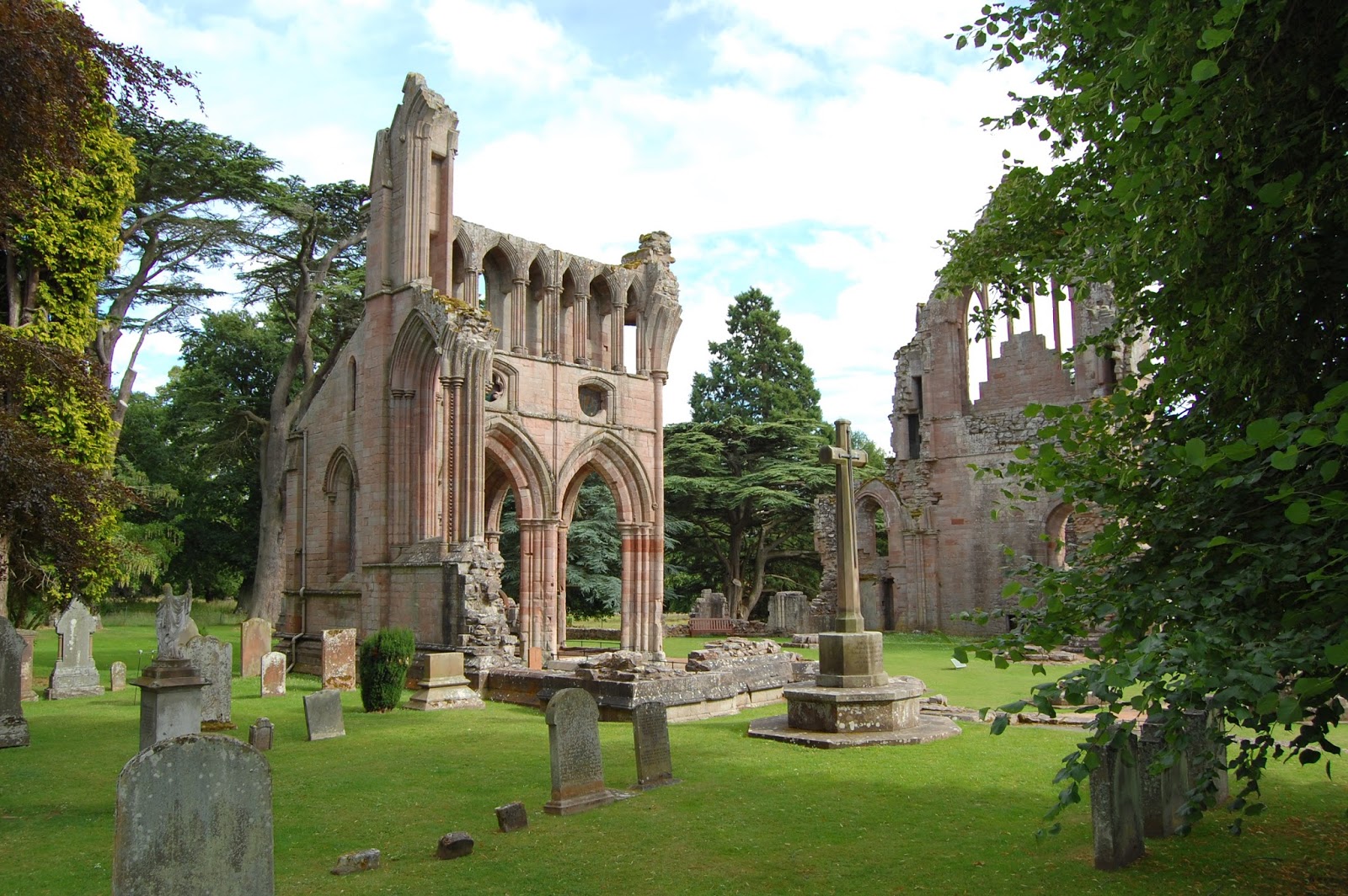
We then drove on to Dryburgh Abbey. This abbey was more remote than the others and gave a sense of seclusion. Only parts of it remain, but you can get a sense of how and where the monks lived within its walls. Of the three abbeys we visited, this was the most friendly for Jack, allowing him ample room to run and climb and explore.
 |
| A corner of the Dryburgh Abbey ruins. |
Given our slow pace, we ran out of time to visit Melrose Abbey, the fourth major Borders Abbey; it is definitely on our list of places to visit in the future. I hope to write more about these abbeys later this week.
On our drive home we stopped at Scott's View, supposedly Sir Walter Scott's favorite vista. It was nice, but nothing spectacular.
 |
| To be honest, this view from the side of the road about 1/4 mile from Scott's View is a better vantage point. |
On Sunday, we decided to sleep as late as Jack would let us, which thankfully turned out to be 8:30 in the morning. Since he usually wakes around 7:00 or 7:30, this was a nice surprise. After a lazy morning we headed to Mugdock Country Park, a sprawling wooded park on the northwestern edge of Glasgow. On our way, we enjoyed the rolling hills and farmland that border the city.
 |
| Cows grazing near the road on the way to Mugdock Country Park. |
We are continually surprised that Glasgow can seemingly disappear once we go around a bend in the road, and suddenly we find ourselves in the midst of countryside.
Mugdock park looks to be a bonanza for hiking, dogwalking, and kid entertainment. We were planning only a quick trip to see what we would find, and ended up spending a couple of hours wandering with Mattie and letting Jackson romp in a play area on the grounds.