Tuesday, August 6, 2013

Rosslyn Chapel

Rosslyn Chapel has the kind of history and mystery that makes me want to believe the conspiracy theories.

I don't believe them. But I want to believe them because it's so much more fun to believe the Knights Templar and Freemasons are tied into the chapel and that secrets are buried underground and coded into the carvings on the walls.

Rosslyn Chapel
Rosslyn Chapel, on an appropriately overcast morning.
The chapel was founded in 1446 by William St. Clair (the family is now known as "Sinclair"). Its general architectural plan seems to be based on the Glasgow cathedral, though much of Rosslyn Chapel was never completed. Some conspiracy theorists apparently argue that the plan of the chapel is based on the Temple in Jerusalem, but the architectural plans don't really line up even if they're twisted or distorted.

Anyway, it's a small chapel — only 69 feet long and 42 feet high — with a profusion of stone carvings, both inside and out. Approximately 40 years of construction on the chapel largely ceased after William St. Clair died.

Rosslyn Chapel exterior from outside the wall
View of Rosslyn Chapel on the opposite side, outside its wall.
Rosslyn Chapel baptistry from Victorian era
In the Victorian era, a small baptistry was tacked onto the western end of the chapel. I'm not a fan of it.
Like most folks, I first heard of Rosslyn Chapel in The Da Vinci Code by Dan Brown, and first saw it in the film of the same name. The general conspiracy theory — though not necessarily what is described by The Da Vinci Code — is that the St. Clair family had historic ancestral ties to the Knights Templar, and when the Templars were destroyed by the Pope and French king Philip IV, some of the members fled to Scotland and took refuge. Eventually, some of the religious artifacts held by the Templars were hidden within or beneath Rosslyn Chapel.

What are those supposed relics? Perhaps the Holy Grail or even the body of Christ.

I simply can't do justice in a mere blog post to the many scholarly and conspiracy theories which abound. You can find plenty with simple internet searches, as well as books, novels, treatises, etc. 

The chapel's exterior is decorated with numerous carvings. Unfortunately, the chapel was built with sandstone and those carvings have taken a beating over the centuries from erosion.

Window archivolt
Archivolt over a window.
Lavish pinnacle of flying buttress
The pinnacles of the chapel's flying buttresses are lavishly carved.
Blackening from coal pollution
The blackening is a remnant of coal pollution during the Industrial Revolution.
Each window has its own unique design and carvings.
Waterspout gargoyle at Rosslyn Chapel
One of the waterspout gargoyles.
While the exterior of the chapel has numerous carvings, it pales in comparison with the inside. The chapel's interior is profusely covered with thousands of stone carvings. Almost all of the walls and ceilings are covered in carvings, many of which appear to present Templar and Masonic symbols and rituals. (The Freemasons were originally a guild of stone masons who often worked in the employ of the Templars for building projects, and perhaps may have secretly continued the Templars after their formal destruction.)

Given its thousands of disparate carvings, Rosslyn Chapel is rife for (mis)interpretation.

The St. Clair/Sinclair family has retained possession of the chapel since its founding. They currently allow no photography inside the chapel, so the pictures of the interior shown here are from their web site for the chapel, unless otherwise noted.

Among the many highlights inside the chapel is the Apprentice Pillar (or "Prentice Pillar"). According to the story, the master mason received from William St. Clair a model of the pillar he wanted. Before the master mason would work on it, he wanted to travel abroad to see the original pillar. The story is vague as to where that pillar was located. While the master mason was traveling, the apprentice mason had a dream of the pillar and completed it before the master mason returned. It was better than anything than the master mason could do himself. Growing jealous when he saw the column, the master mason took his mallet and struck the apprentice mason on the head, killing him. The master mason was then executed for his crime, and his face was carved into the chapel and forced to stare at the apprentice's pillar.

Unfortunately, this story first came about in the 18th century, hundreds of years after the completion of the chapel.

Apprentice Pillar inside Rosslyn Chapel
Apprentice Pillar.
It's a truly beautiful and striking pillar, with dragons ringing the base, vines and leaves wrapping upward around the pillar, and foliage at the top. I think it's the most accomplished carving in the chapel.

Among the many other carvings are Freemason symbols of angels in unusual positions, like this one of a fallen angel (Lucifer) hanging upside down and bound with rope:

Fallen angel, Lucifer, hanging upside down
"Lucifer," fallen angel upside down and bound with rope.
Then there are the many "Green Men" — more than 100 — who are scattered throughout the building. These are ancient pagan symbols of fertility and growth, with vines exiting the mouth showing unity between nature and man. Rosslyn Chapel is a nominally Christian space immersed in Masonic and Celtic images.

Green Man
Green Man, photo courtesy of Wikipedia.
While the Green Men are ancient Celtic symbols, the chapel also includes modern images (for the 15th century). For example, bagpipes first appeared in Scotland in the early 1400s, and the chapel has one of the first known images of bagpipes, with an angel squeezing out a tune:

Angel playing bagpipes
Bass drone pipe off to the side of his head, tenor drone tucking behind his head, bag under his arm, chanter in his hands, but no blowpipe for the mouth.
I also must mention the 213 cubes or boxes. Sticking out from arches and pillars, these carved boxes have a variety of patterns on them which many people think bear a code or set of instructions. What do they mean? As yet, no one has shown a definite pattern or interpretation. One recent interpretation is musical notes, and a "Rosslyn Motet" — not a good one, incidentally — has been composed from it.

213 cubes with patterns
213 of these little cubes?  They gotta mean something!
Rosslyn Chapel visitor center
The striking visitor's center.
We spent nearly two hours at the chapel, wandering inside and out. It has a newly-built visitor center — you can see the Masonic influence — with nifty displays. It's state of the art with interactive computer displays.

Our visit to Rosslyn Chapel was on a weekend in the summer, which meant it was crowded. So crowded, in fact, it became almost claustrophobic. With hundreds of carvings throughout the building, there aren't just a few locations that draw all the attention. Consequently, people stop and stand willy-nilly without regard to allowing others to pass, making it difficult to maneuver. It was even harder for Kate, who had Jackson on her back in a hiking backpack — great for keeping him contained but hard to navigate without bumping people.

I look forward to returning on a weekday in the fall or winter, when the crowds will be small and I can have more time to study the carvings. It is one of the most unique chapels/churches I have come across in Europe.

What do you think? Have a nagging suspicion that the conspiracy theorists might be right?


Monday, August 5, 2013

Weekend activities

We had a fun weekend of family-friendly tourist sites. Jackson and I started on Friday morning with a walk to a nearby construction site. We spent 30 minutes watching from various vantage points, as diggers dropped dirt into dumpers, forklifts carried stacks of wood, and cement mixers swirled and deposited cement. Our walk last Wednesday had similarly passed this construction site.  Last Thursday Jackson was distressed that rain prevented any construction activities, so I knew watching construction on Friday would be a hit. In fact, we spent almost 30 minutes this morning (Monday) at the construction site, and we would have spent more time except the workers went on break. I fear we're becoming construction site groupies.

Jackson likes to instruct the workers: "Diggers keep moving!"  "Dumpers back up!"
Jackson currently is smitten with construction vehicles, most particularly diggers. When reading before naptime or bedtime, out of more than 100+ books he almost always picks books about construction vehicles, whether it's a picture book naming various machines or a book about dinosaurs operating construction vehicles. This obsession follows earlier obsessions with trains ("choo choos") and airplanes. I suppose it's really an obsession with any vehicles, since he usually carries around a school bus, police car, and Hummer. Vehicles -- metal, plastic, Lego, small, large, old, 70s-vibe, new -- are his daily raison d'ĂȘtre. 

Later on Friday morning, Jack and Grammar and I headed over to the Kelvingrove Art Museum and Gallery.

Kelvingrove Art Museum and Gallery. Jackson abandoned pushing his pram {Ed.'s note: that's "stroller" to you Americans} and exited stage right to chase pigeons.
This wonderful museum was a big hit with Jackson, though we ventured into only three of its many rooms. Indeed, Jack easily could have spent a couple of hours wandering in just one of the main exhibit halls, which bursts with stuffed wildlife, a WWII plane, and myriad random pieces. In other rooms are art galleries and a multitude of exhibits on things like ancient Egyptians and Scottish history and architecture and so on. I'm sure I'll write more about Kelvingrove at a later time, since it looks destined to be part of our regular kiddo (and adult) entertainment.

One of the large exhibit halls in the Kelvingrove museum.
Jackson saw that the plane had no pilot and asked, "Pilot napping?"
We ate lunch at the Kelvingrove while listening to one of the daily organ concerts. The organ is adequate and certainly fills the room with sound, but the musical selection on Friday -- emphasizing fluff like "Memories" from Cats -- was disappointing.

Tuna fish sandwiches go well with organ concerts.
After three hours in the Kelvingrove we went home for naptime and playing in the park.

On Saturday, we took a driving tour through some of the Borders region of Scotland. We stopped first at Rosslyn Chapel, most recently famous because of The Da Vinci Code.

Mysterious Rosslyn Chapel emerges at the top of a hill.
Rosslyn Chapel is a wonder of stonemasonry and carving. Much of the interior of the chapel is covered with intricate carvings and friezes. A number of scholars conspiracy theorists like to find hidden meanings in the carvings, claiming secret knowledge and connections to the Freemasons and Knights Templar. Unfortunately, photography isn't allowed inside the chapel. Later this week I plan to write a longer post about the chapel.

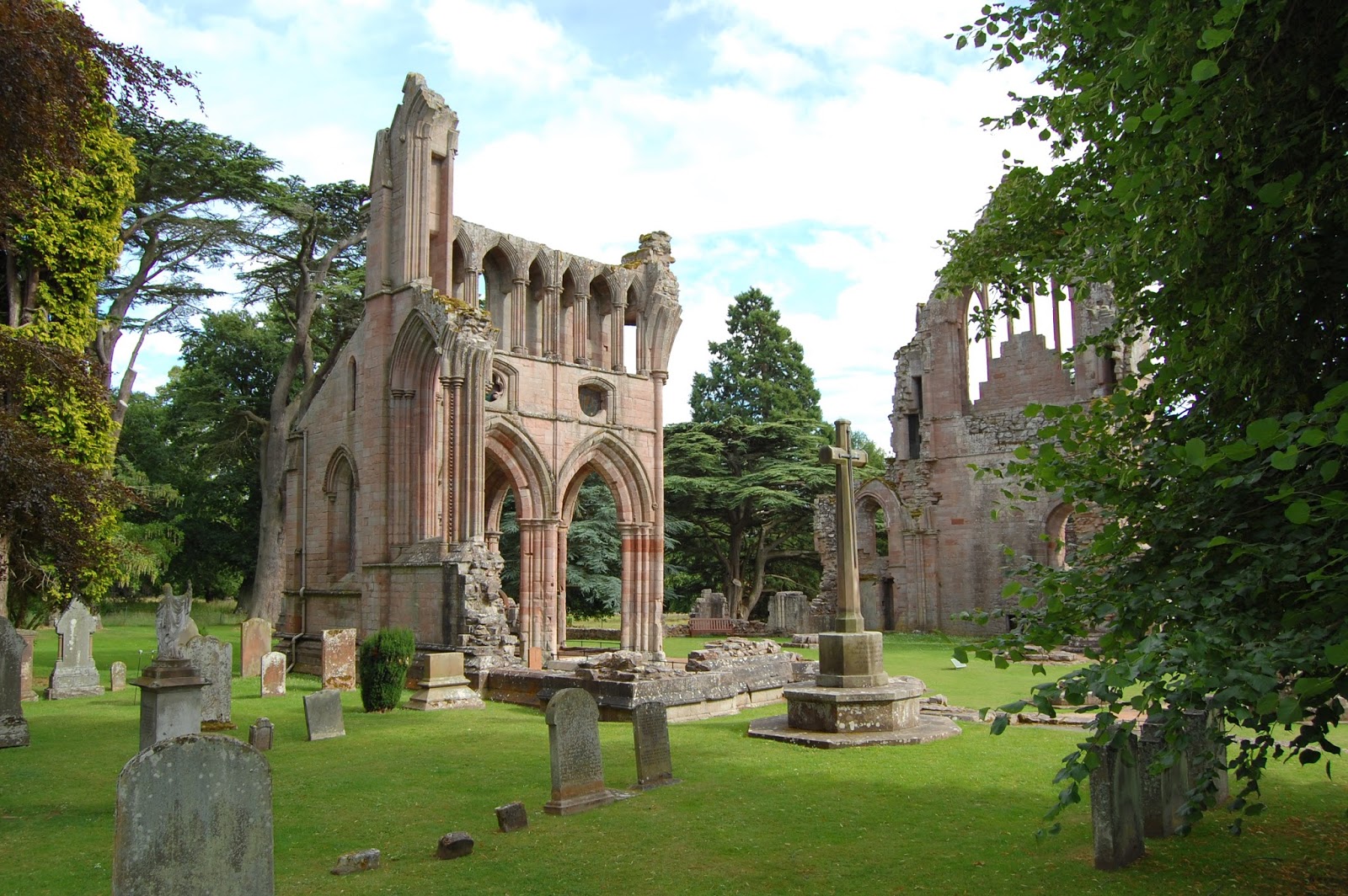
We then traveled south through the rolling hills to the Border Abbey ruins of Kelso, Jedburgh, and Dryburgh. These magnificent abbeys were the subjects of repeated attacks by English armies during wars between England and Scotland. The abbeys were mostly destroyed by armies of Henry VIII in the 1540s. They linger as evocative ruins, open for clambering exploration and photography bait.

We first visited Kelso Abbey, of which little remains. These ruins are worth only a short stop, since there isn't all that much left of the abbey to see.

Kate in red provides a sense of the size of the Kelso Abbey ruin. 
The town of Kelso is charming, and we had a fun meal at The Hoot 'n' Cat Coffee Shop, which we highly recommend. They offered buckets of toys for the wee ones to play with, cooked fast and tasty food, had clean bathrooms, and supplied cheerful service. We wish we could transplant The Hoot 'n' Cat to Glasgow.

The Hoot 'n' Cat is a terrific coffee shop in Kelso.
We stopped next at Jedburgh Abbey. It was the most impressive of the ruined abbeys we visited.  Though it has no roof, its walls still thrust skyward. The abbey has a storybook or movie-quality ambience.

Kate taking a breather from chasing Jackson around the ruins of Jedburgh Abbey.
It was impossible to take a bad photograph of Jedburgh Abbey.

We then drove on to Dryburgh Abbey. This abbey was more remote than the others and gave a sense of seclusion. Only parts of it remain, but you can get a sense of how and where the monks lived within its walls. Of the three abbeys we visited, this was the most friendly for Jack, allowing him ample room to run and climb and explore.

A corner of the Dryburgh Abbey ruins.
Given our slow pace, we ran out of time to visit Melrose Abbey, the fourth major Borders Abbey; it is definitely on our list of places to visit in the future. I hope to write more about these abbeys later this week.

On our drive home we stopped at Scott's View, supposedly Sir Walter Scott's favorite vista. It was nice, but nothing spectacular.

To be honest, this view from the side of the road about 1/4 mile from Scott's View is a better vantage point.
On Sunday, we decided to sleep as late as Jack would let us, which thankfully turned out to be 8:30 in the morning. Since he usually wakes around 7:00 or 7:30, this was a nice surprise. After a lazy morning we headed to Mugdock Country Park, a sprawling wooded park on the northwestern edge of Glasgow. On our way, we enjoyed the rolling hills and farmland that border the city.

Cows grazing near the road on the way to Mugdock Country Park.
We are continually surprised that Glasgow can seemingly disappear once we go around a bend in the road, and suddenly we find ourselves in the midst of countryside.

Mugdock park looks to be a bonanza for hiking, dogwalking, and kid entertainment. We were planning only a quick trip to see what we would find, and ended up spending a couple of hours wandering with Mattie and letting Jackson romp in a play area on the grounds.


Sunday, August 4, 2013

Visitors from 'Murica

When you move to another continent, you figure you probably won't see many people you know.  But in our seven weeks here in Glasgow, we've already had five houseguests.  We also have visited with three more old friends in Edinburgh when they popped into town for a wedding.  We're expecting one or two visitors in August, and at least two more houseguests in September.

What are we, a hotel?

Truthfully, it has been fantastic to have so many friends and family from home visiting us.  Our first and still current houseguest is Kate's mom, Ginnie, who generally is called "Grammar" around our house.  Why is she called "Grammar" instead of "Grandma"?  Her name was coined for her oldest granddaughter and grandson, Macie (age 11) and Garrick (age 9), who know their grandmother is a grammar maven.  Hence, "Grammar."  She will (gently) correct your grammar.  She actually knows the difference between laying down and lying down.  When Kate was growing up she would ask, "Mom, will you make me a sandwich?", and get the reply, "Poof, you're a sandwich!"

Self-portrait by Katie with her mom while hiking in Glen Coe.
Grammar has been here since we arrived in Scotland.  She flew with us from the States to be a helper and babysitter and cook.  When Kate and I have been busy with tasks and errands such as buying a car or having the satellite television installed, she has taken over childcare duties to allow us to get things done.  It's remarkable how much a toddler can slow you down, so Grammar has been worth her weight in gold.  She also helps with household chores, makes some meals (the best ones), decorates and beautifies with gardening, entertains the wee one, and provides general good cheer.  By the time she leaves in mid-August we'll have squeezed out two months of work from her.

Jackson's toddler perspective of his Grammar.
Our other four houseguests were Kate's oldest sister, Tracy; Tracy's husband, John; their daughter, Macie; and their son, Garrick.  They left last week after three weeks with us.  It was a fun packed household, five adults and three kids.  Fortunately, our townhouse has four (small) bedrooms, with a playroom/bonus room which functioned as a fifth bedroom for Macie and Garrick.  We were able to buy and assemble a double bed and single bed from Ikea before they arrived, so Ginnie and Tracy and John had beds.  Macie and Garrick were stuck with just an air mattress, but didn't seem to mind.  We haven't bought a dining table yet -- we're in the market for a drop-leaf table that can be either pushed out of the way or expanded as needed -- so mealtime was often on the couch and chair and floor, a usefully communal style of eating that kept everyone relaxed and our toddler entertained.

Ringing the bell on Her Majesty's Yacht Britannia, (l) to (r):  Tracy, Garrick, Macie, John, Grammar, Kate, Jackson, Brian.
We did a lot of touristing with Kate's family, even though Kate was hard at work in her new job.  We all spent a weekend in St. Andrews, and sans Kate we visited multiple cities on day trips and explored our local environs.  Tracy and John and their kids also headed north for a couple of multi-day trips into the highlands for some sightseeing and hiking.  We tried to cram as much into their trip as we could, but hope they'll return at some point for even more.

From the first day of their visit, Macie and Garrick were Jackson's new favorite people.  We would hear through the baby monitor first thing in the morning, "Garrick?  Macie?  Wake up, Garrick!"  We'd go into his room and instead of the usual "Mommy!" or "Daddy!" he'd ask "Macie?" or "Garrick?"  Jackson followed them everywhere.  They spent endless hours entertaining him, whether playing with Duplo Legos, kicking balls, going to the park next to our house, or riding in the car together.  While he usually scoffs at holding mommy's or daddy's hands as an affront to his toddlerhood, Jackson happily held hands with Macie and Garrick to walk down the sidewalk.  If we had thrown a sheet over him he would've looked just like E.T. waddling down the street holding hands with Elliott and Michael on Halloween.  They were his moon and stars, his alpha and omega.  He still hasn't processed that they have left to return home.  If he sees a car parking near our house, he asks, "Garrick here?" 

As for our other visitors, we were able to have a (too quick) visit with my longest-term friends, Karen and Dan, and Karen's husband, Will.  I have known Karen and Dan since they were born; our mothers have been best friends since growing up in Cleveland.  Karen is the first girl to see me naked -- aged around 2 or 3 months old, as we bathed together.  When I grew up, their parents were "Aunt" Sally and "Uncle" Glenn, and Dan and Karen were my "cousins."  My fondest family memories always include them at Thanksgiving or Christmas, playing games or sledding or causing mischief.  Dan and "Aunt" Sally even came to Raleigh before Kate and I moved to Scotland, for a "Thanksgiving in May" farewell.

Lunch in Edinburgh, (l) to (r):  Jackson, Brian, Karen, Will, Kate, Dan.
Karen and Dan came to Scotland for a friend's wedding in Edinburgh, so I insisted on imposing by going to visit them while they were nearby.  We had only a few hours to eat and wander and chat, but it was great to see them.  From my not so subtle inquiries at lunch, it seems that Karen, Will, and Dan all have skills that would easily transfer to the job market here in the U.K.  "Uncle" Dan and "Aunt" Karen really should consider moving to Scotland, so we can create new holiday traditions.

Jackson is quite pleased to have Dan tote him through a garden in Edinburgh.
Fleeing gleefully from Karen.
All of these 'Murican visitors have kept at bay any feelings of homesickness.  That should continue into the fall, at which point we don't have any visitors scheduled.  {Ed.'s note: there are at least two spare bedrooms for any folks itching to visit.}  It's both busy and energizing to have so many visitors.  They have prevented us from unpacking . . . umm, who am I kidding, they've been a useful excuse to stop unpacking!  Meanwhile, they have been a great excuse to go be tourists.  Will we be lonely once October rolls around and we're left to ourselves?